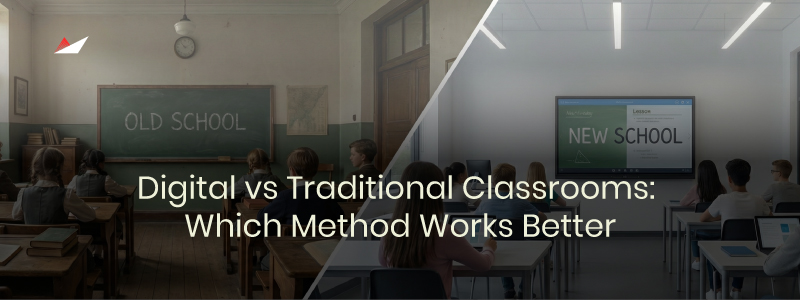
In recent years, conversations about classroom education in India have changed dramatically. Once dominated by blackboards and textbooks, education today stands at a crossroads where technology in education is reshaping how teachers teach and how students learn. But with both digital classrooms and traditional classrooms offering unique advantages, one question keeps coming up: Which one really works better?
Think of it like choosing between a classic bicycle and an electric bike. Both will get you to your destination, but the experience, speed and effort involved will differ. In the same way, both learning environments serve a purpose—but the impact varies depending on how they’re used.
Before we decide which is “better”, let’s take a deeper look at what each offer.
What Are Traditional Classrooms?
Traditional classrooms are what most of us grew up with—physical rooms, chalkboards, face-to-face interaction and a structured timetable. They offer:
- Human connection between teachers and students
- Clear routines and discipline
- Hands-on activities
But they also come up with limitations such as limited learning pace, fixed curriculum delivery and sometimes lack of engagement.
What Are Digital Classrooms?
A digital classroom uses digital tools, audio-visual content, interactive screens, teacher apps, and online learning platforms. Here, technology plays a major role. Key elements include:
- Smartboards in classrooms
- Learning management systems
- Virtual classrooms
- Tablet or laptop-based learning
These make learning more interactive, flexible, and personalized.
The Rise of Technology in Education India
In India, the adoption of technology in education has skyrocketed. From metro cities to rural towns, schools are embracing the smart class model. This includes:
- Digital content libraries
- Recorded lessons
- AI-based assessment tools
- Online tests
This rise is driven by the necessity (post-pandemic) and the demand for future-ready students.
Digital Tools That Are Transforming Classrooms
Digital tools have become essential teaching aids. Popular tools include:
- Interactive Panel
- VR/AR Learning
- Multimedia displays
- Real-time collaboration
Digital Learning vs Traditional Learning: Key Differences
Here’s a quick comparison:
| Traditional Classroom | Digital Classroom |
| Fixed pace | Flexible pace |
| Limited visuals | Multimedia-rich lessons |
| Teacher-centered | Student-centered |
| Physical presence required | Accessible anywhere |
| Limited assessment formats | Instant assessments |
Senses Interactive Panels: Transforming Classrooms into Smarter Learning Spaces
Education is evolving faster than ever, and classrooms today require more than textbooks and traditional teaching tools. Schools, colleges and training institutions are looking for solutions that make learning more engaging, seamless and future-ready. This is exactly where Senses Interactive Panels step in.
Designed for modern teaching environments, Senses Panels bring together simplicity, power and interactivity, giving educators everything they need to create impactful, technology-enabled learning experiences.
Why Senses Interactive Panels?
- A Seamless Teaching Experience
No complex setups. No external devices are required.
Senses Panels allow teachers to walk into a classroom and start teaching instantly. The intuitive interface, lightning-fast response, and user-friendly tools make it easy for educators of all skill levels to adopt.
- A Truly Interactive Classroom
The panels turn every lesson into an immersive experience.
Teachers can annotate, draw, highlight, browse the internet, display videos, and engage students with tools designed for real-time interaction. With multi-touch capability, students can collaborate right on the screen, making learning more interactive.
- Crystal-Clear Visuals and Smooth Performance
Whether it’s a biology diagram or a geography map, clarity matters.
Senses Interactive Panels offer vivid displays, smooth writing and lag-free operation—ensuring that content is always sharp, engaging and easy to follow.
- Powerful Built-In Teaching Tools
From a scientific calculator to geometric rulers and spotlight functions, Senses Panels come packed with smart tools teachers use every day. No extra software is required.
This saves time, simplifies lesson delivery, and boosts teaching efficiency.
- Enhanced Connectivity and Compatibility
Senses Panels work effortlessly with laptops, tablets, document cameras and external devices. With versatile connectivity options, teachers can switch between sources instantly and deliver lessons without interruption.
- Designed for Digital Learning
With cloud integration, screen recording and wireless screen sharing, Senses Panels make hybrid learning and digital content delivery easier than ever. Lessons can be recorded, saved and revisited—perfect for revision and remote education.
Future-Ready Technology for Future-Ready Learners
As classrooms across India and beyond move toward smarter, technology-integrated learning, Senses Panels offer a solution that:
- Enhances teaching
- Simplifies operations
- Drives better student outcomes
- Supports digital transformation
They are not just an upgrade—they are the new standard for modern classrooms.
Conclusion
Senses Interactive Panels empower teachers, inspire students, and transform the way learning happens. With intuitive tools, strong performance, and seamless interaction, they redefine what a smart classroom can be. For institutions looking to bring technology into everyday teaching, Senses Panels deliver impact, efficiency and a learning experience that truly stands out.